Everything Is Connected: How Scarborough’s Reading Rope Ties It All Together
I want to tell you about a student I’ll call Lily.
Lily came to me during a summer reading academy, placed there after scoring poorly on her third-grade state reading assessment. She was bright, eager to please, and completely confused about why reading felt so hard. Her classroom teacher had tried everything she could think of — extra phonics practice, leveled readers, comprehension strategy worksheets. Some things helped a little. Nothing helped enough. As we began working together, I noticed it wasn’t one glaring weakness that was holding her back. It was several small ones, each tugging at the others. Her phonological awareness was shaky. Her vocabulary was thin for her age. She struggled with longer sentences. She had almost no background knowledge about the topics she was expected to read. No single strand was broken beyond repair. But together, the weaknesses were enough to unravel the whole.
Later, I would come across a model called Scarborough’s Reading Rope — a framework that maps every skill involved in learning to read. When I looked back at Lily, I saw it clearly.
Reading isn’t one skill. It’s many skills, woven together. And when any one of them is weak, the whole rope frays.
A Quick Word About the Simple View
Before we get to the rope, it helps to start with a simpler picture.
In 1986, cognitive scientists Philip Gough and William Tunmer proposed what they called the Simple View of Reading. Their formula:
Decoding × Language Comprehension = Reading Comprehension
In plain terms: the ability to read words on the page, multiplied by the ability to understand what those words mean. It’s elegantly concise. If a child can recognize words on the page but can’t understand language, comprehension fails. If a child understands language beautifully but can’t decode the words, comprehension also fails. Both sides of the equation are necessary. Neither alone is sufficient.
The Simple View gave researchers and educators a powerful framework — and over 150 studies have since supported it. But it’s a useful summary, and a high-level one. It tells us what reading requires at the highest level without telling us what goes into each side of the equation. That’s where Scarborough comes in.
Introducing the Rope
In 2001, literacy researcher Dr. Hollis Scarborough published a model in the Handbook of Early Literacy Research that has since become one of the most widely used frameworks in reading science. Developed to help parents and educators understand how children learn to read, the model maps the many skills involved in skilled reading and shows how they work together. She called it the Reading Rope.
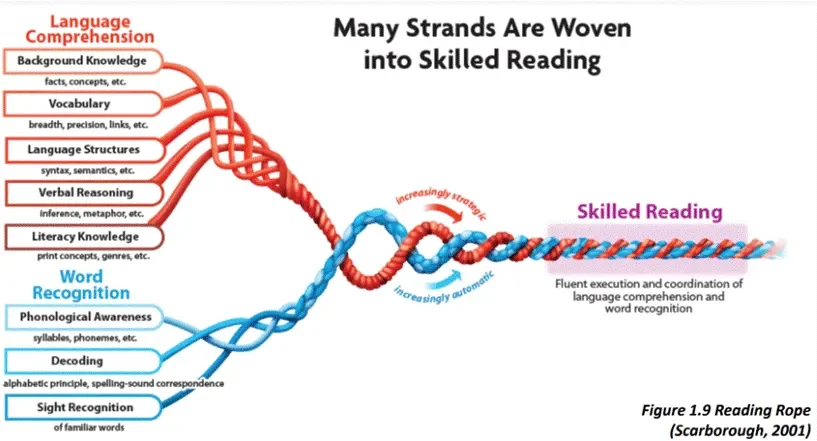
Image Credit: International Dyslexia Association
The rope has two main sections. The lower strands represent Word Recognition: the skills that allow a reader to accurately and automatically identify the words on the page. The upper strands represent Language Comprehension: the skills that allow a reader to understand what those words mean once they’ve been decoded. Woven together over time — through instruction, practice, and experience — they produce a skilled reader.
What makes the rope such a useful model isn’t just what it includes. It’s what it shows: that all these strands develop at the same time, not in sequence. A child doesn’t master word recognition and then move on to comprehension. Both sides of the rope are being built at the same time, strand by strand, from the very beginning.
Image: Scarborough’s Reading Rope, adapted from Scarborough (2001). Infographic courtesy of the International Dyslexia Association.
The Lower Strands: Word Recognition
Word Recognition is made up of three strands: phonological awareness, decoding, and sight recognition of familiar words. If you’ve been reading this series, these are old friends.
Phonological awareness
...is the ability to hear and manipulate the sounds inside words — to notice that cat has three sounds, that play and stay rhyme, that you can take the /k/ off cat and get at. It’s the auditory foundation that makes learning to read possible. If you read the phonological awareness articles earlier in this series, you know that this strand begins developing long before a child picks up a book, and that explicit instruction matters enormously for children who don’t develop it naturally.
Decoding
...is what happens when a child uses their knowledge of letter-sound relationships to translate written words into spoken ones. It’s the work of the phonics article: the systematic, explicit instruction that teaches the brain to crack the written code. As we explored in that article, this strand starts with simple consonants and short vowels and builds toward complex patterns, vowel teams, and morphology. With enough practice, decoding becomes automatic — so fast and effortless that the reader doesn’t even notice it happening anymore.
Sight recognition of familiar words
...is that automaticity: the ability to recognize a word instantly, without having to sound it out. This is where the fluency article and the high frequency words article both connect: as decoding becomes practiced and automatic, words shift from being laboriously decoded to being instantly recognized. High frequency words (the words that appear most often in written text) are particularly important here, because a reader who can recognize them instantly, without stopping to sound them out, has more mental energy available for the work of understanding what they’ve read. The brain has built its reading superhighway. The lower strands of the rope have become strong.
The Upper Strands: Language Comprehension
Language comprehension is where the series gets even richer, because this is where so many of the articles come together at once.
Background knowledge
...is everything a reader already knows about the world before they pick up a text. As we explored in the background knowledge article earlier in this series, writers assume readers will supply the missing context. A reader without relevant background knowledge hits invisible walls on every page, even when they can decode every word perfectly. This strand never stops growing — we build it through experiences, conversations, books, and the kind of unhurried exploring that summer allows.
Vocabulary
...is the reader’s store of word meanings — not just recognizing a word, but knowing what it means, how it relates to other words, and how its meaning shifts across contexts. The vocabulary article explored how vocabulary gaps compound over time, and why rich, explicit word instruction is so much more effective than hoping children will absorb words through exposure alone. A reader with a thin vocabulary will stumble not on decoding but on meaning — the words are there, but they don’t connect to anything.
Language structures
...covers how sentences work: grammar, sentence structure, and the way ideas connect and build on one another within a sentence — and the meaning carried within and between words. This is the territory of the syntax article, the oral language article, and the semantics mini: a child who hasn’t developed strong oral language, who hasn’t heard and used complex sentences in conversation, or developed a feel for how word meanings shift and connect, will struggle to process them on the page. Reading doesn’t build language structure from scratch; it draws on the language a child already carries.
Verbal reasoning
...(or thinking through what you read) is the ability to go beyond what’s on the page: to make inferences, interpret figurative language, read between the lines. It’s the territory of the comprehension article: reading isn’t passive reception, it’s active construction of meaning. A skilled reader uses what they know to fill in what the text leaves unsaid. This strand is perhaps the most invisible, rarely taught explicitly, and yet it’s the one that determines whether a child truly understands what they’ve read, or merely processes it.
Literacy knowledge
...is understanding how written language works as a system: how books and different types of text are organized, how punctuation signals meaning, how nonfiction tools like headings, captions, and diagrams work. This is the territory of the print concepts article: the foundation laid in the earliest years of reading development, when children learn that print carries meaning, that words are made of letters, that we read left to right and top to bottom. It seems basic. But without it, the whole system is shaky.
What the Rope Tells Us
Here is the most important thing the rope shows us: a weak strand anywhere weakens the rope everywhere.
A child who is a strong decoder but has thin vocabulary will hit a ceiling. A child with rich language comprehension but shaky phonological awareness will struggle to get words off the page. A child with beautiful background knowledge but poor language structures will understand the world but struggle to make sense of complex sentences on the page. Reading difficulty is almost never one thing. It’s usually several strands pulling at each other — which is why understanding the full rope matters so much.
The rope also shows us something hopeful: every strand can be strengthened. Phonological awareness can be taught explicitly. Decoding can be systematized. Vocabulary can be built deliberately. Background knowledge can be accumulated, one experience and one book at a time. The strands are not fixed. They grow with instruction, practice, and time.
And they grow together. That’s the point of the rope. Not a checklist of skills to master in sequence, but a living, intertwining system — each strand reinforcing the others, all of them working simultaneously toward the same goal: a child who can read anything, understand it fully, and keep reading because they want to.
The Bottom Line
Scarborough’s Reading Rope is the clearest map we have of what skilled reading actually requires. It tells us why reading is hard, not because any one skill is impossibly difficult, but because so many skills must develop at the same time and work together seamlessly. It tells us why children struggle, usually not because one strand is catastrophically broken, but because a few are weaker than they need to be. And it tells us what to do: build every strand, deliberately and explicitly, from the very beginning.
If you’ve been following this series from the beginning, you’ve already been learning the rope — strand by strand, article by article. This is what it looks like when it all comes together.
Your Turn
Looking back at the strands in the rope, which one surprises you most? Which one do you wish you’d understood earlier in your teaching or parenting journey?
If you’re a parent: when you think about your child’s reading, which strand feels strongest? Which one feels like it might need more attention?
If you’re a teacher: how has understanding the full rope changed the way you think about reading assessment or instruction? Have you ever had a student whose difficulty you couldn’t quite name — and now you can?
Subscribe so you don’t miss a post!
