What Children Need to Know Before They Can Read
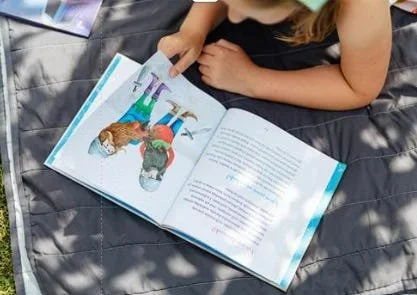
Pick up a book. Find the front cover. Locate the title. Open it and start reading from the top left, moving your finger under each word as you go, left to right, then sweeping back to the next line when you reach the end. When you get to a word you don’t know, you know to stop and work on that word.
You did all of that without thinking. Every single step was automatic.
Now consider what a child who has never been read to is doing when they pick up that same book. They may not know which end is the front. They may not know that the title is the big text at the top. They may not know that the squiggles on the page are what tell the story. They may not know that reading moves left to right, or that those white spaces between clusters of letters mean something. They are looking at a page of organized symbols with almost no understanding of what any of it means.
That understanding has a name: print awareness. And it is the foundation that has to exist before any other reading instruction can take hold.
It sounds obvious. It is not — not to a child who hasn’t figured it out yet.
What Print Awareness Actually Includes
Print awareness is not a single skill. It is a cluster of understandings that develop gradually through early childhood, typically through exposure to books and print in the environment. Here is what it covers:
Book handling
Books have a front cover and a back cover. The title is on the front. There is an author — the person who wrote the words — and often an illustrator who drew the pictures. Pages are turned one at a time from front to back. Text and pictures serve different purposes.
Directionality
We start at the top left. We read left to right. When we reach the end of a line, we sweep back to the left and move down. The print is what we are reading, not the picture.
The concept of a word
Words are made of letters. Words are separated by spaces. Some words are long and some are short. The spoken word “cat” matches the printed letters c-a-t.
The concept of a letter
Letters are different from words. Letters combine to make words. The letter b is different from the letter d — direction matters for letters in a way it does not for objects. (If you read the mirror writing article in this series, you know exactly why this is harder than it sounds.)
Voice-print match
When someone reads aloud and points to each word, the spoken words line up with the printed words one to one. This understanding — that each spoken word matches a unit of print — is a significant milestone.
Punctuation
A period means stop. A question mark signals a question. An exclamation point signals excitement or emphasis. These marks carry meaning that affects how text is read and understood.
Why It Matters
Research consistently identifies print awareness as an important early predictor of reading success — a skill that, when missing, leaves children without the foundation they need to make sense of instruction. Children who arrive at kindergarten without solid print awareness face a steeper climb, not because they are less capable, but because the instruction they receive assumes a starting point they haven’t yet reached.
Think about what happens when a child who doesn’t yet have voice-print match — the understanding that each spoken word has a printed counterpart — sits down for phonics instruction. The teacher points to the word “cat” and sounds it out. But if the child doesn’t yet understand that the cluster of letters between those two spaces is a single word — the same word the teacher just said — the instruction has nowhere to land. The brain needs that foundation before it can make use of what is being taught.
This is why print awareness comes before everything else in learning to read — before phonics, before fluency, before any of the five pillars of reading we have explored in this series. It is the entry point.
It develops alongside phonological awareness — the ability to hear the sounds in spoken language — and the two together lay the groundwork for phonics to take hold.
And here is the good news: print awareness is not difficult to build. It develops naturally in children who are surrounded by books and print — who are read to regularly, who see adults handling books, who have their own books to explore. For children who arrive with less of this experience, purposeful but simple attention to print during read-alouds can make a meaningful difference.
What Parents and Teachers Can Do
1. Finger under the words
This is one of the most direct ways to build print awareness. When you run your finger under the words as you read aloud, you are showing a child exactly what voice-print match looks like in practice. The spoken word and the printed word land together. Over time, children absorb this without being told — because they have seen it hundreds of times.
For parents and teachers: even a short read-aloud done consistently builds this understanding. It takes seconds and teaches something essential.
2. Narrate the ritual
Before you open a book, narrate the ritual. “Let’s find the front cover. Here is the title — that is the name of the book. This says who wrote it — the author. And this is the illustrator — the person who drew the pictures.” These comments seem small. For a child building their understanding of how books work, they are not small at all.
3. Print is everywhere
Print is everywhere — on cereal boxes, street signs, menus, storefronts, labels. Pointing to print in the world and saying “that word says stop” or “that sign is the name of our street” builds the basic understanding that print carries meaning before a child ever opens a book.
For teachers: classroom print — labeled shelves, name cards, word walls, morning message — serves this purpose clearly. The key is to actually use them — point to them, read them, refer to them. A label no one mentions is just decoration.
4. Books in their hands
Before children can read, they can explore. Give young children access to books — real books, not just toys. Let them turn pages, look at pictures, hold the book upside down and right side up. Every one of those moments is print awareness in the making.
The Bottom Line
Print awareness is the thing that has to come first. It is what has to be in place before phonics instruction makes sense, before voice-print match clicks into place, before a child understands what reading actually is. For children who have been surrounded by books and read to from an early age, much of this develops naturally. For children who arrive at school without it, clear and early attention to print concepts makes an enormous difference.
The ritual of picking up a book, finding the title, and reading left to right is so deeply absorbed in skilled readers that we forget it was ever learned. But it was. And every child needs the chance to learn it.
Your Turn
Think back to your earliest memory of being read to. Do you remember someone pointing to the words? Do you remember the moment voice-print match clicked — when you realized each spoken word had a printed counterpart?
If you are a parent: do you point to words when you read aloud? Has your child ever surprised you with a question about how print works?
If you are a teacher: what do you notice about print awareness in your incoming students? Is there a concept that tends to be missing most often?
Subscribe so you get every post!
