Reading Starts With Your Ears — And That Changes How We Teach It (Part 1)
We all remember clapping out syllables in our names — I always had bragging rights with four. Or playing rhyming games. Or stumbling through silly tongue twisters. All of these “games” are actually serious brain work, quietly preparing children to become readers.
No letters involved. No books. No reading at all. Just sounds.
That ability — to hear and manipulate the sounds in spoken language — is called phonological awareness. It is one of the most powerful predictors of future reading success we have, and most parents have never heard of it.
Researchers can predict with remarkable accuracy whether a kindergartner will struggle to read — not by looking at how many books are in their home, not by testing their vocabulary, and not by measuring their general intelligence. They can do it by listening to how well that child hears and plays with the sounds in words.
You have probably heard of phonics. Maybe you have flashbacks to letter-sound cards or sounding out words on a page. Phonics is important — but without phonological awareness, phonics instruction has nothing to stick to. Phonological awareness is the foundation that has to be built first. And understanding the difference between the two changes everything about how you support a young reader.
Let’s Get Clear on the Difference
The confusion between phonological awareness and phonics is so common that even experienced educators sometimes mix them up. Here is a simple way to keep them straight:
Phonological awareness is about sound only. No print involved. It is the ability to hear that the word “sunshine” has two parts or syllables (sun-shine), to recognize that “cat” and “hat” rhyme, and to understand that “dog” is made up of three separate sounds: /d/ /ŏ/ /g/. A child can work on phonological awareness with their eyes closed.
Phonics is about connecting sounds to letters on a page. It is the understanding that the /d/ sound is spelled with the letter d, that “sh” together makes a single sound, and that the silent e at the end of a word changes the vowel sound. Phonics requires print.
Think of it this way: phonological awareness is learning to hear the music before you ever pick up an instrument. Phonics is learning to read the sheet music. You can appreciate music and even hum a tune without reading notation — but learning to read music goes a lot faster if your ears are already trained.
The National Reading Panel’s landmark 2000 review confirmed it: explicit phonemic awareness instruction significantly improves reading and spelling outcomes — especially when it develops alongside letter-sound instruction.
What Phonological Awareness Actually Looks Like
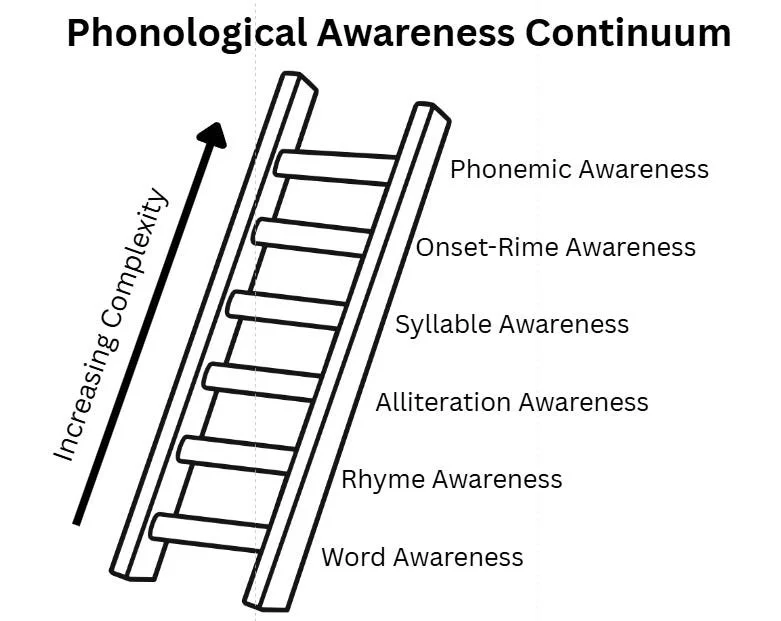
Phonological awareness is not a single skill. It is a family of related skills that develop along a continuum — from noticing big chunks of language all the way down to manipulating individual sounds. Researchers David Chard and Shirley Dickson described this as a continuum of complexity, moving from larger, more concrete units of sound toward smaller, more abstract ones.
Here is what that continuum looks like in practice:
Word Awareness
Before anything else, children learn that spoken language is made up of separate words. This sounds obvious to adults, but for a young child, speech flows together as one continuous stream of sound.
Rhyme Awareness
One of the earliest phonological skills to emerge is the ability to hear rhyme — to notice that “cat,” “hat,” and “mat” share a sound pattern at the end. Children typically develop rhyme awareness before they can identify individual sounds, which is why nursery rhymes and rhyming books are such powerful early literacy tools. They are not just fun; they are training the ear to detect sound patterns in words, which is foundational for later phonics work. Recognizing that two words rhyme comes before producing rhyme (coming up with a word that rhymes with “cat”), so watch for both as separate milestones.
* Note that researchers don’t fully agree on where rhyme sits in this sequence — some frameworks place it earlier, some later, but most agree it emerges naturally in the early years and is worth nurturing regardless of its exact position on the continuum.
Alliteration Awareness
Closely related to rhyme is the ability to notice that words share a beginning sound — that “Sally sells seashells” all start with the same sound, or that “Peter Piper picked a peck” keeps returning to that same /p/ sound. This is alliteration awareness, and it is an early indicator that a child is tuning in to the sound structure of language rather than just its meaning. Tongue twisters and alliterative books are not just silly fun — they are building exactly this awareness.
Syllable Awareness
Children start to notice that words have parts, or beats. “But-ter-fly” has three parts called syllables. “Dog” has one. Children learn that each syllable is built around one vowel sound. Clapping syllables in names is a classic early childhood activity — and it is genuinely building a foundational reading skill, not just keeping kids busy. Syllables will come in handy when children move on to phonics and decoding unknown words.
Onset-rime Awareness
A syllable can be split into two parts: the onset (the initial consonant sound) and the rime (the vowel and everything that follows it). In the word “cat,” the onset is /k/ and the rime is /-at/. Noticing that “cat,” “hat,” “mat,” and “sat” all share the same rime is onset-rime awareness. Onset-rime awareness is the foundation for word families in phonics instruction.
Phonemic Awareness
At the top of the continuum sits phonemic awareness — the ability to hear and manipulate individual phonemes. Phonemes are the smallest units of sound in spoken language. A phoneme is just a single sound. The word “cat” has three phonemes: /k/ /ă/ /t/ Phonemic awareness includes skills like blending sounds into words (/k/ /ă/ /t/ / = “cat”), segmenting words into their individual sounds (“cat” = /k/ /ă/ /t/ ), and manipulating sounds to make new words (change the /k/ in “cat” to /b/ to get “bat”).
© Decoding Learning, 2026
An important note: this is not a rigid staircase where children must master each level completely before moving on. Research shows that children develop skills at multiple levels simultaneously, with earlier levels supporting progress at later ones.
Why This Matters More Than Almost Anything Else
Here is the finding that stops me every time I revisit it. Researchers have followed children from kindergarten through the early grades and found that phonological awareness is one of the strongest predictors of how well children will read — and that this relationship holds up year after year. A large longitudinal study (a study that followed the same children over several years) of 570 children found that kindergarten phonological awareness predicted 2nd grade reading outcomes even after accounting for other factors like vocabulary and letter knowledge (Hogan, Catts & Little, 2005). That is not a blog post or a company’s marketing claim. That is peer-reviewed science, replicated across multiple studies.
What is especially striking is that phonological awareness predicts reading success independently — meaning its power shows up even when you account for what a child already knows about letters and sounds. We are not talking about a skill that shows up after reading begins — we are talking about a skill that lays the groundwork for whether reading takes hold at all. This does not mean that weak phonological awareness causes every reading difficulty — reading is complicated and involves many interacting factors. But the research is consistent: phonological awareness is one of the most reliable early indicators we have.
Psychologist Keith Stanovich introduced what he called the “Matthew Effect“ to reading research in 1986, drawing on the biblical idea that the rich get richer and the poor get poorer. In reading, children who develop strong early phonological skills learn to decode words more efficiently, which leads to more reading practice, which builds vocabulary and comprehension, which makes reading more enjoyable, which leads to even more reading. The cycle feeds itself.
The reverse is also true. Children who struggle with phonological awareness find decoding hard. When decoding is hard, reading is slow and effortful. When reading is slow and effortful, children avoid it. Research on exactly how that gap compounds over time is mixed — but what is consistent is this: early reading struggles rarely resolve on their own. The gap does not reliably close without intentional support.
This is why phonological awareness matters so much early. The earlier the foundation is built, the better the odds of avoiding that downward spiral.
How This Connects to Brain Science
If you read my earlier article on how the brain learns to read, you may remember the “Reading City” framework and the three brain regions that work together to make reading possible. Phonological awareness lives in Sound City, or the parietal lobe, the region responsible for connecting sounds to symbols.
Before a child can use Sound City to link the letter d to the /d/ sound, the way their brain processes sounds needs to have already isolated that /d/ sound as a distinct unit. That is phonological awareness doing its job. It is the training ground that makes Sound City’s work possible.
And remember the reading superhighway — the brain pathway that eventually allows skilled readers to recognize words instantly without sounding them out? That superhighway cannot be built on a weak phonological foundation. The explicit instruction in phonological awareness that researchers recommend is not a detour; it is the road construction itself.
There is also a connection to the mirror writing article, where we explored how the brain learns to treat visually similar letters like b and d as distinct. Part of what helps the brain make that distinction, as I mentioned, is phonological input: the letter b makes a /b/ sound while d makes a /d/ sound, and those different sounds help anchor the different shapes. Phonological awareness is already in the mix before children ever pick up a pencil.
The Bottom Line
Phonological awareness is the auditory foundation on which all of reading is built. Before a child can decode a word, they need to be able to hear the individual sounds that make up that word. Before they can use phonics to connect sounds to letters, their brains need practice isolating, blending, and manipulating sounds in spoken language.
It develops along a predictable continuum — from broad awareness of words and syllables down to fine-grained manipulation of individual phonemes. And the research is clear: children with strong phonological foundations learn to read more easily, more quickly, and more independently.
The practical implication is encouraging: you do not need to wait for school to start this work. The rhyming games, the silly word play, the nursery rhymes you might think of as “just” fun are doing genuine cognitive work. They are training the brain to hear exactly what it will need to hear when it is time to learn to read.
Next week, we’ll go deeper: what does it look like when phonological awareness is not developing on track? What should parents and teachers watch for, and what does targeted support actually look like? We’ll also dig into some of the research-backed strategies and approaches that can be used to support children.
Your Turn
Had you heard of phonological awareness before today? Think back to those rhyming games and silly tongue twisters from your own childhood — did you realize that was serious brain work happening? Drop a comment and tell me what surprised you most about the science behind it.
Subscribe so you don’t miss Part 2, coming next week.
