Reading Isn't Natural—And That Changes Everything: What Neuroscience Tells Us About Learning to Read
Many of us have experienced young children spotting their favorite restaurant and then shouting out the name. Or a toddler recognizing their name on a birthday card. Or maybe it’s a four-year-old reciting their favorite book from memory, using their finger to trace under the words they’ve heard a hundred times. Parents often assume their child is “reading.” And that is true in a sense. But it is more accurate to say they are recognizing symbols or memorizing something they heard or seen many times. While this may be exciting to see, it is important to understand that this isn’t reading the way their brain will need to read “The cat sat on the mat” or later, “photosynthesis” in a science textbook.
Here’s the truth that changes everything about how we teach reading: Reading is not a natural human ability.
Unlike speaking, which humans are biologically wired to do, reading is a relatively recent invention—only about 5,000 years old. Our brains didn’t evolve to read. There is no “reading center” in the brain waiting to be activated. Instead, learning to read requires the brain to repurpose areas designed for completely different tasks and create entirely new brain pathways.
Understanding this fundamental fact is the key to understanding why some children struggle to read, why certain teaching methods work better than others, and why explicit, systematic instruction matters so much.
The Brain’s Reading Renovation Project
Let’s start by looking at what goes on in the brain. When a child learns to read, their brain essentially undergoes a renovation. Areas designed for other purposes get repurposed, rewired, and connected in new ways.
Three main brain regions work together to make reading possible:
Occipital Lobe sits at the back of your head and was designed to process visual information, helping you recognize faces and spotting that snake on the hiking trail. When learning to read, this region gets repurposed to recognize letters and words as distinct visual symbols. It learns that “b” and “d” are different letters, even though they’re basically the same shape flipped around—something that wouldn’t matter when identifying an object like a cup or the face of a loved one.
Parietal Lobe sits in the middle part of the brain and processes sensory information including helping you understand spatial relationships. For reading, it gets recruited to connect sounds to symbols---understanding that the letter “d” corresponds to the /d/ sound, and that letters blend together to form words. For example, the brain learns to connect d-o-g to the sounds /d/ /ŏ/ /g/ and blend them into the word “dog.”
Temporal Lobe sits on the side of the brain, and it handles processing sounds and language comprehension. It was already working when a child listens to their environment and learns to speak. For reading, it is repurposed to connect written symbols to the language it already knows. This is where meaning-making happens—where the decoded word “dog” connects to everything your child knows about dogs.
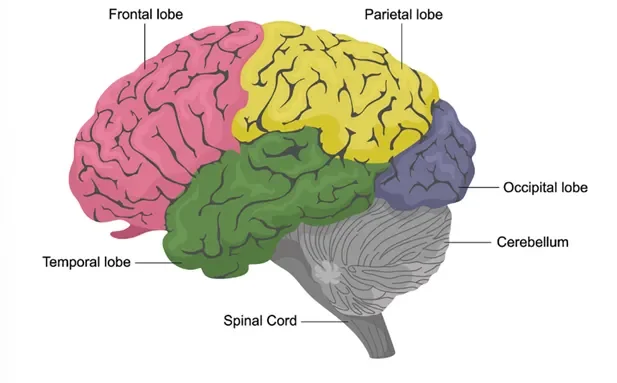
Parts of the brain
Reading City: A Framework for Understanding
I had the privilege of attending a conference session given Dr. Carolyn Strom. She created a helpful framework called “Reading City” that makes this brain science easier to understand and visualize. She describes three key areas working together:
Vision Village (occipital lobe) is where letter recognition happens. This is the entry point—your child’s brain needs to see the letters clearly and recognize them as distinct symbols.
Sound City (parietal lobe) is where the action happens. This is where letters get connected to sounds, where phonics live, where your child’s brain learns to decode. This area has to work hard, especially in English where the same letter can make different sounds (think about the “a” in “cat,” “cake,” and “call”).
Meaning Mountains (temporal lobe) is the destination—where all that decoding work pays off and becomes comprehension. The brain connects the decoded word to language and meaning.
For beginning readers, the journey from Vision Village through Sound City to Meaning Mountains is slow and effortful. But here’s where it gets interesting.
The Reading Superhighway
Remember learning to drive? At first, you had to think about every single action: Check mirror. Signal. Brake. Turn wheel. It was exhausting. But eventually, your brain created shortcuts—brain pathways that made driving feel automatic.
The same thing happens with reading.
With practice and proper instruction, the brain creates what neuroscientist Stanislas Dehaene calls the “visual word form area“—what I think of as a reading superhighway. This shortcut connects Vision Village (occipital lobe) directly to Meaning Mountains (temporal lobe), bypassing the slow route through Sound City (parietal lobe).
When you see the word “dog,” you don’t sound it out letter by letter anymore. Your brain recognizes it instantly and accesses its meaning. The superhighway is working.
But here’s the critical part: This superhighway doesn’t just appear. It has to be built through explicit instruction in phonological awareness, phonics, and practice.
When children learn to decode (occipital → parietal → temporal), they’re building the foundation. When they learn to encode—to spell and write (temporal → parietal → occipital)—they’re reinforcing those pathways from both directions. Eventually, with enough quality practice, the brain creates that automatic recognition pathway.
Why This Matters for Teaching and Parenting
If reading were natural—if children’s brains were designed to do it—we could just expose them to books and expect reading to emerge, the way speaking emerges from exposure to language.
But because reading requires the brain to be rewired, it requires explicit teaching.
Children need:
Phonological awareness instruction to help their brains hear and manipulate sounds in words.
Systematic phonics instruction to build those sound-symbol connections in Sound City.
Fluency practice to strengthen the pathways and build the reading superhighway.
Vocabulary instruction to ensure Meaning Mountains has something to work with.
We’ll dive deep into each of these in future articles. But for now, the most important takeaway is this: When a child struggles to learn to read, it’s not because they’re not trying hard enough or because something is wrong with them. It’s because their brain is being asked to do something it wasn’t designed to do—and that requires the right kind of help.
The reading superhighway can be built. But it needs the right materials, the right blueprints, and the right construction process.
Your Turn
Did any of this surprise you? Has understanding how the brain learns to read changed how you think about teaching or helping your child?
I’d love to hear your “aha” moments in the comments. What surprised you most - that reading isn’t natural, how the brain regions work together, or something else? And if you’re a teacher or parent working with a struggling reader, what questions do you have about what we covered today?” What you ask shapes what I write next, so tell me what you are wrestling with.
