What to Watch For — And What to Do: A Practical Guide to Phonological Awareness (Part 2)
Here is something the research tells us that I find genuinely hopeful: explicit phonological awareness instruction works. The National Reading Panel reviewed decades of research and found that teaching children phonological awareness skills significantly improved their reading, across a wide range of children, across a wide range of teaching conditions, and starting as young as preschool. Not just in clinical settings with specialists. In classrooms, with everyday activities, delivered by teachers who understand what they are doing and why.
That matters because phonological awareness is one of the most important foundations for learning to read, and research identifies it as the most common source of difficulty when early reading does not take hold. When a child struggles to learn to read, the most likely explanation is not effort or intelligence. According to researchers, it is most often a gap in the ability to process language at the sound level. And that kind of gap, with the right support, can be addressed.
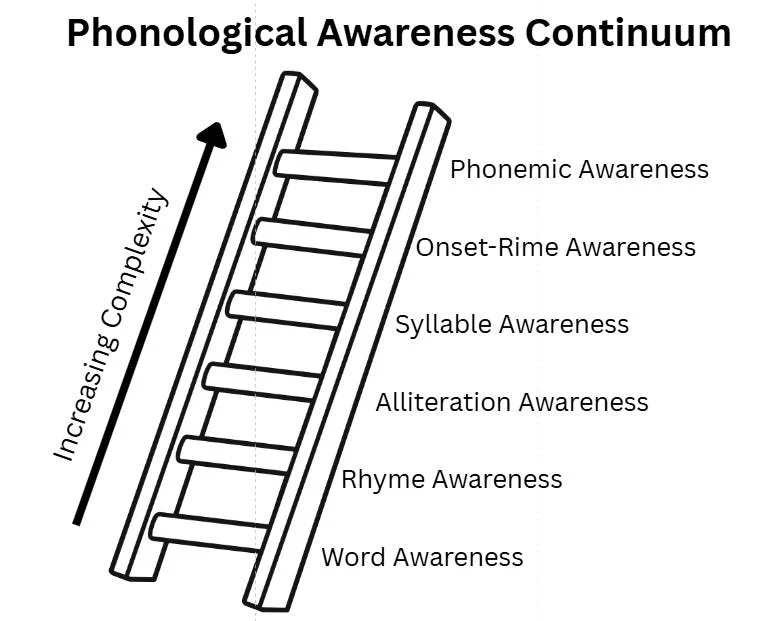
In Part 1, we explored what phonological awareness is, why it predicts reading success, and how it develops along a continuum from broad sound awareness down to individual phoneme manipulation. If you also read the brain science article, you already have a picture of where phonological awareness lives in the brain. In Sound City (parietal lobe), the region responsible for connecting sounds to symbols. Today we go practical: what does typical development look like at different ages, what are the signs that a child may need more support, and what can parents and teachers actually do about it?
© Decoding Learning, 2026
What Phonological Awareness Looks Like at Different Ages
Phonological awareness develops in a predictable sequence from less complex to more complex skills. The milestones below are drawn from Moats and Tolman (2009), who synthesized several research reviews to identify the ages at which 80 to 90 percent of typical students have achieved specific phonological skills. These are general benchmarks. Children develop at their own pace, and a child who is a few months behind on one skill is not necessarily cause for concern. What matters more is the overall pattern over time.
Around age 4: Enjoying rhyme and noticing alliteration
At age 4, most children are beginning to enjoy rhyme and alliteration through play. They can recite familiar rhyming words from books and songs, join in with alliterative phrases like “Peter Piper picked. . .,” and are starting to notice when words sound similar. This is not yet intentional phonological work — it is playfulness with sound. But that playfulness is building the auditory sensitivity that everything else depends on.
Around age 5: Rhyme recognition, syllables, and beginning sounds
By age 5, skills become more deliberate. Most children can recognize whether two words rhyme (“Do cat and bat rhyme?”), clap or count the syllables in words, and begin to identify the first sound in familiar words. Producing a rhyme, like coming up with a word that rhymes with “car,” emerges around age 5 and a half, and is harder than simply recognizing rhyme. Research by Paulson (2004), cited in Moats and Tolman, found that only 61 percent of 5-year-olds entering kindergarten could produce a rhyming word. This is a useful reminder that what seems simple to adults is genuinely hard for young children.
Around age 6: Individual sounds come into focus
In kindergarten and early first grade, children move into the most fine-grained level of phonological awareness called phonemic awareness, which is working with individual sounds in words. By age 6, most children can blend two or three sounds (phonemes) into a word (/k/ /ă/ /t/ = cat), and can segment simple short words into their individual sounds. These are the skills that directly power early reading and spelling. Paulson (2004) found that only 29 percent of 5-year-olds entering kindergarten could blend single sounds into whole words, which confirms why explicit instruction at this level matters so much. If you read the mirror writing article, you saw this in action. One reason children learn to distinguish b from d is that the two letters make different sounds, and those sounds help anchor the shapes in the brain. Phonological awareness and letter knowledge build each other from both directions.
Ages 6–9: More advanced sound manipulation
Phonological awareness continues to develop well into the elementary years. By age 6 and a half, most children can segment words with blends (like trick or clap) and substitute sounds to build new words. By age 7, they can delete sounds from words (say team without the /m/). More complex deletion tasks, involving blends and middle sounds, develop through ages 8 and 9.
Signs That a Child May Need More Support
A single missed milestone is rarely cause for alarm. Children develop at different rates and have different amounts of exposure to language-rich experiences at home. What matters more is a pattern of difficulty, especially when it persists over time despite lots of exposure to books, songs, and playful language activities.
Chard and Dickson note that a lack of phonemic awareness should not be mistaken for a disability. Many children simply need more explicit instruction than they have received. They also note that most children, with or without disabilities, are likely to benefit from phonological awareness instruction. The response to a gap is more support, not a label.
With that in mind, here are patterns worth paying attention to:
In preschool (ages 3–5):
• Consistent difficulty noticing or enjoying rhyme by age 4, even after lots of exposure to rhyming books and songs
• Unable to clap or tap the syllables in familiar words like their own name by age 4 or 5
In kindergarten (ages 5–6):
• Cannot reliably recognize whether two words rhyme
• Struggles to break familiar words into syllables
• Cannot identify the first sound in a simple, familiar word
• Has significant difficulty putting two or three spoken sounds (phonemes) together to make a word
In first grade and beyond:
• Has difficulty with manipulating (adding, deleting, substituting) sounds in words
• Reading remains slow and effortful, with frequent errors on short, simple words
• Spelling consistently leaves out vowel sounds or middle sounds in words
• Avoids reading tasks or gets frustrated quickly
Researchers Hogan, Catts and Little followed 570 children and found that phonological awareness and word reading have a reciprocal relationship throughout the early grades. Phonological awareness supports reading, and reading in turn strengthens phonological awareness. The two build each other. This means children who fall behind in one area may also fall behind in the other, each gap making the other harder to close. If this sounds familiar, it is the same pattern described in Part 1 as the Matthew Effect. Early support interrupts that cycle.
What Parents Can Do at Home
Here is some hopeful news: the activities that build phonological awareness do not require special materials, a teaching degree, or a set-aside lesson time. Many of them are things families have done for generations. They just work better when you understand why. Here is what the research supports:
Rhyming Books and Songs
Bryant and colleagues found a strong relationship between early knowledge of nursery rhymes and later success in reading and spelling, even after accounting for differences in family background and IQ. Rhyming books and songs train the ear to detect sound patterns, which is exactly the kind of sensitivity that underlies phonological awareness. Passive listening helps, but active participation helps more. Pause before a rhyming word and let your child fill it in. Once a book is familiar, ask: do these words rhyme? Then: can you think of another word that rhymes? Recognizing rhyme comes before producing it, so watch for both as separate milestones.
Clap Syllables
Chard and Dickson place syllable-level work squarely in the middle of the phonological awareness continuum — not the simplest skills, but not the hardest either. Practicing it requires nothing but your hands and a willingness to be a little silly. At the dinner table, clap the syllables in everyone’s name. At the grocery store, tap out ap-ple or straw-ber-ry. These small moments are genuine literacy work.
Play Sound Games
Ask: what sound does pizza start with? What sound do you hear at the end of dog? Beginning sounds are easiest to isolate, ending sounds come next, and middle sounds are hardest. The National Reading Panel identified segmenting and blending individual sounds as the skills most directly linked to reading improvement. Keep it playful. If your child gets it wrong, just model the correct answer cheerfully and move on.
Talk Like a Robot
Blending and segmenting, putting sounds together to make a word and breaking words apart into individual sounds, are the skills the National Reading Panel identified as most directly linked to reading improvement. Speak a word in a slow, stretched-out robot voice: /m/ … /o/ … /m/ … what word is that? Then switch roles and let your child be the robot. Children love it, and blending practice done consistently builds one of the most foundational reading skills there is.
Play with Sound Substitution
Chard and Dickson suggest that swapping out the first sound of a familiar song is a simple and effective way to build phonological awareness. In practice this means: pick a sound and replace the beginning of every word you say with it. Everything becomes a c word. Hello becomes cello. Let’s read a book becomes Cet’s cead a cook. It is ridiculous — and fun! Children find it hilarious. And it is directly building the ability to swap out individual sounds, one of the most sophisticated skills on the continuum.
One practical tip from the National Reading Panel: focusing on one or two skills at a time is more effective than trying to cover everything at once. Do not try to do it all. Pick one activity, do it consistently and joyfully, and let it become part of your routine before adding another.
What Teachers Can Do in the Classroom
For teachers, the National Reading Panel’s findings point clearly toward explicit, systematic instruction as the foundation. Here is what the evidence specifically supports:
Teach It Explicitly
Chard and Dickson note that phonological awareness can be developed before reading begins and that it helps children learn to read more successfully. But for many children, rich language exposure alone is not enough. The National Reading Panel concluded that children at risk of reading failure especially need direct and systematic instruction in these skills, provided as early as possible. Do not wait for children to pick it up.
Focus on One or Two Skills
The National Reading Panel found that the most effective instruction focused on one or two types of phoneme manipulation rather than several at once. Resist the urge to cover the entire continuum in a single unit. Spend meaningful time at each level before moving on. Depth over breadth, especially in the early grades.
Small Groups for Targeted Practice
The National Reading Panel found that small-group phonological awareness instruction produced significantly stronger results than whole-class instruction — in fact, the effects were roughly twice as large. Where possible, pull small groups for focused phonological awareness practice, particularly for children showing early signs of difficulty.
Connect Sounds to Letters
One of the National Reading Panel’s clearest findings is that explicitly teaching children to work with sounds alongside letters was among the most effective approaches. Once children have some letter knowledge, connect the sounds they are practicing to the symbols: that /m/ sound, that is the letter m. This is how phonological awareness becomes phonics, and making the connection explicit accelerates progress in both directions. As explained in the brain science article, this is Sound City doing its job, linking sounds to symbols to build the reading pathways the brain needs.
Keep it playful
The National Reading Panel specifically found that children in kindergarten and first grade respond well to phonological awareness and phonics instruction when it is delivered in a “vibrant, imaginative, and entertaining” way. This is not a soft suggestion. It is a research-supported instruction. Songs, games, puppets, and silly voices are not decorations on top of real instruction. For young children, they are the instruction. So have fun with it!
The Bottom Line
Phonological awareness gaps are not a verdict. They are a signal, and one that responds well to early, intentional support. The National Reading Panel concluded that the evidence for explicit phonological awareness instruction is clear enough that it should be a standard part of reading instruction for children who have not yet developed these skills.
If you are a parent who noticed some of the patterns above, do not panic. Start with the simple, joyful activities in this article, share them with your child’s teacher, and if concerns persist, ask about a formal screening. The earlier you act, the more options you have.
And if you are a teacher, you are already doing more of this work than you may realize. Every time you lead a rhyming game, every time you clap syllables in a word study lesson, every time you stretch out the sounds in a word with a student who is struggling, you are building the foundation that reading depends on. The research backs you up.
Next week we will move on to the next of the five pillars of reading: phonics. We will look at what systematic phonics instruction actually means, what the research says we should be doing in classrooms, and why the conversation around phonics has been so contentious for so long.
Your Turn
Which of these activities are you already doing without realizing it was literacy work? And if you’re a teacher, what phonological awareness strategies have made the biggest difference in your classroom? Drop a comment. I’d love to hear what is working for you.
Subscribe so you don’t miss the next article!
