Read It Aloud: Why Reading Aloud Matters at Every Age
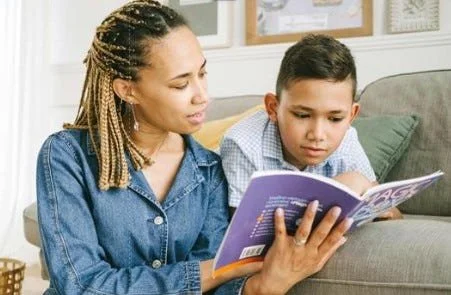
Something happened every time I started a read aloud — regardless of the grade level.
Students who had been tuned out, restless, or physically present but mentally elsewhere would go still. Whether it was a picture book I was using to illustrate a concept, a chapter book we were working through together, or a poem I wanted them to hear before they read it themselves, the room shifted. The same student who had been staring at the ceiling was suddenly leaning forward.
I noticed this across grade levels. Elementary kids. Middle schoolers. Even high school students who had long since decided that school wasn’t for them. Something about being read to — about hearing a story told well — reached them in a way that independent reading assignments often didn’t.
The research explains why. And it makes a case that reading aloud isn’t just a nice thing to do for young children. It is one of the most powerful literacy tools we have — at every age, in every grade, and in every home.
The Research Is Clear — and Has Been for a Long Time
In 1985, a landmark U.S. Department of Education report called Becoming a Nation of Readers (Anderson, Hiebert, Scott & Wilkinson) identified reading aloud to children as among the most important activities for building the knowledge required for eventual success in reading.
The finding was not limited to young children or struggling readers. It applied broadly — and decades of research since then have continued to support it.
A large review of research by Swanson and others (2011) examined 29 studies on read aloud interventions for children ages 3–8 at risk for reading difficulties and found “significant, positive effects on children’s language, phonological awareness, print concepts, comprehension, and vocabulary outcomes.” But the benefits don’t stop when children learn to decode. They continue to accumulate well past the point where a child can read independently, and the reasons why tell us something important about how language and literacy actually work.
What Read Alouds Actually Build
Oral language. Before a child can comprehend what they read, they need to be able to comprehend what they hear. This is not a small distinction. Oral language — the vocabulary, syntax, and listening comprehension that children develop through speaking and listening — is widely recognized in reading research as the foundation on which literacy is built. Research shows that children’s listening comprehension outpaces their reading comprehension until at least the middle school years. That gap is not a problem — it is an opportunity. Read alouds fill it. When a child listens to a fluent reader working through a complex text, they are developing the oral language skills that will eventually power their reading comprehension.
Vocabulary. Written language, especially the kind children encounter in books, contains vocabulary they would rarely hear in everyday conversation. Isabel Beck’s research — which you may remember from the vocabulary article in this series — identified Tier 2 words as the high-value academic vocabulary that appears frequently in written texts but almost never in spoken language. Read alouds are one of the main ways children encounter those words. A child who is read to regularly is building a word bank that a child reading only independently (limited to texts at their own level) simply cannot access.
Showing what good reading sounds like. When a skilled reader reads aloud expressively, pausing at punctuation, varying pace and tone, grouping words into meaningful phrases, they are demonstrating what fluent reading sounds and feels like. Children absorb this model. Research consistently finds that hearing fluent reading is one of the conditions that supports the development of reading fluency (the bridge, as we explored in the fluency article, between decoding and comprehension).
What good readers do. A read aloud is also one of the best settings in which to model comprehension strategies: predicting, questioning, making inferences, monitoring understanding. When a teacher pauses and says, “Wait — that surprised me. Let me think about why,” they are making the invisible visible. Students see what a thoughtful reader actually does with a text, not just what they produce at the end of it.
Access to complex texts. A student who reads at a fourth-grade level independently can access and engage with texts written at a much higher level when they are read aloud. The work of sounding out words — the effort that consumes so much of a beginning reader’s attention — is lifted, and understanding becomes the focus. This matters for building vocabulary, background knowledge, and the kind of sophisticated thinking that challenging texts demand.
Does It Still Matter After They Can Read on Their Own?
Yes, though it is worth being honest about what the research shows at different ages.
For younger children, the evidence is strong and consistent. For middle school students, research supports read alouds particularly for vocabulary development, reading fluency, and engagement. Surveys of both middle school teachers and students, cited by Reed and Petscher (2014), found that read alouds were believed to support comprehension and motivate students to complete assignments.
What does not appear to diminish with age is the pull of a good story read well. Most teachers who have read aloud to older students will tell you the room changes — that students who are checked out during other parts of the lesson lean in. That is not a research finding. It is something teachers have been observing for a long time, and it is worth naming honestly alongside the evidence.
What Parents and Teachers Can Do
1. Reading aloud beyond independence
The moment a child begins reading on their own is not the moment to stop reading aloud to them. It is the moment to start reading books they cannot yet access independently — stories and texts above their current reading level, rich in vocabulary and ideas. This is where the greatest vocabulary and comprehension gains happen.
For teachers: read alouds do not have to be long. Even ten to fifteen minutes of reading aloud (a chapter, a picture book, a poem, an article) builds oral language, models fluency, and builds community around text.
2. Stop and talk
The research is consistent on this: the discussion that surrounds a read aloud is what deepens its impact. Before reading, activate what children already know about the topic. During reading, pause to think aloud, define unfamiliar words in plain language, and invite predictions. After reading, ask questions that go beyond recall: why did the character make that choice? What was the author trying to tell us?
For parents: this does not need to be structured or formal. Talking about a book the way you might talk about a movie (what surprised you, what you noticed, what you wondered) is exactly the kind of discussion that builds comprehension.
3. Texts above their level
The read aloud sweet spot is a book the child could not yet read fluently on their own but can follow and enjoy when it is read to them. This is where vocabulary grows fastest, where listening comprehension is stretched, and where the gap between what a child can hear and what they can read begins to close.
4. Modeling genuine engagement
Read with expression. Vary your voice. Show that you are affected by what you are reading — that something surprised you, or moved you, or made you think. Children who see adults genuinely engaged with text develop a very different relationship to books than children who receive the message, however unintentional, that reading is a task to complete.
The Bottom Line
Reading aloud to children is not a preschool activity dressed up for older grades. It is a genuine literacy tool with documented benefits for vocabulary, oral language development, fluency, comprehension, and engagement — benefits that continue well past the point where children can read independently.
The research makes a strong case. But so does the quiet that falls over a classroom when a story begins. That is not nothing. That is a brain leaning in, a reader in the making, a relationship between a child and language being formed one page at a time.
Your Turn
Do you have a memory of being read to as a child (a book, a teacher, a parent, a moment)? Did it shape how you feel about reading today?
If you are a parent: are you still reading aloud to your child even though they can read independently? What books have you shared that way?
If you are a teacher: what has been your experience reading aloud to older students? Have you noticed the engagement shift that the research describes?
Subscribe so you get every post!
