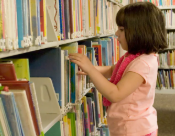
The library has always been my happy place.
When I was growing up, my mom would take me to the bookmobile — a traveling library that stopped at the gas station near our house a couple of times a month. Getting there felt like an event. But making an actual trip downtown to the main branch, two floors full of books, was a really big deal.
In fourth grade, I became a library aide. I got to check books in and out. It was the highlight of my week.
I loved it so much that about fifteen years into my career, I went back and got a master's in library and information science. Not because I needed to. Just because I wanted to.
I think about that a lot now, writing articles and resources for families and teachers. The library wasn't just a place I loved — it was one of the most important things shaping my reading life, even when I had no idea that's what was happening. And I'm often struck by how many children today never go at all. Not because their families don't value reading. But because no one has told them what a library actually offers — or what the research says it can do.
Here is what fifteen years of studying it has taught me: access to library resources is one of the most powerful, low-cost levers we have for supporting children's literacy. And most families are not using it.
What the Data Actually Shows
In 2008, researchers Keith Curry Lance and Robbie Bravman Marks analyzed national data comparing children's library circulation rates and program attendance with fourth-grade reading scores on the NAEP — the closest thing we have to a national reading report card. States where children checked out more library materials tended to have higher reading scores, with a relationship strong enough to be meaningful.
Perhaps most striking: parental education level — one of the strongest predictors of reading achievement — explained significantly less of the variation in scores once library use was factored in. The researchers concluded that library access may help narrow the gap that family education levels alone would otherwise predict.
This type of research shows a relationship, not a cause — it can't prove that libraries made the difference on their own. But the pattern is consistent: the children using libraries most tend to be the children reading best.
That pattern shows up in a specific and practical way over the summer months.
Summer Reading Loss — and What Libraries Can Do About It
You've probably heard of "the summer slide" — the tendency for children to lose reading ground when school is out. It is real and well-documented. A 2019 analysis of more than 3.4 million students across all 50 states found typical losses of one to two months in reading over summer. The children most affected tend to be those who had the least access to books and reading support to begin with.
Libraries are one of the most practical responses we have. A 2017 study found that children in a structured summer reading program showed no signs of summer reading loss at all. A 2024 study of nearly 7,000 students in Ohio and Michigan found that children who participated in summer reading showed meaningful gains in reading scores — and in high-poverty schools, those gains were even larger.
The cost to participate: free.
Aaron Dworkin, CEO of the National Summer Learning Association, put it plainly: "Public libraries are uniquely positioned to help all kids rise and to close these gaps."
It Starts Earlier Than You Think
The benefits don't begin when a child starts school. Library storytime programs — songs, rhymes, read-alouds, and shared book experiences — build exactly the foundational skills that predict how easily a child will learn to read: phonological awareness (the ability to hear and play with the sounds in words), vocabulary, and print concepts (things like knowing that text moves left to right and that letters represent sounds).
Think of them as a pre-reading runway. Children who arrive at kindergarten with more book exposure and more awareness of how print works tend to take off faster when formal reading instruction begins.
What to Actually Do
The research points to something families and educators already sense intuitively: libraries work. Here is what the evidence suggests for using them well:
1. Make it a habit, not a one-time trip
Consistent library use — not a single visit — is what predicts stronger reading outcomes. Going every week or two normalizes reading as a regular part of life. The goal is not to borrow a pile of books and never return. It is to make the library part of your family's rhythm.
2. Sign up for summer reading before school ends
Most public libraries run structured summer reading programs beginning in June. Sign up before school ends and put it on the calendar the same way you'd mark swim lessons or camp. For families without transportation, many libraries offer digital borrowing through apps like Libby or Hoopla — free with a library card.
3. Use the librarian
Children's librarians are trained to match readers with books. A child who says "I don't like reading" or "There's nothing good" often just hasn't found the right book yet. A children's librarian can change that in a single conversation.
4. Go for more than books
Today's libraries offer audiobooks, e-books, museum passes, literacy kits, storytime programs, STEM activities, and book clubs — often free. The library card sitting in a wallet or junk drawer may be worth considerably more than most families realize.
More Than Reading — A Place to Belong
The research case for libraries is strong. But there is something the data doesn't fully capture: libraries are genuinely fun, and they are one of the few truly public spaces left where families are welcome to just show up.
Story times, summer reading kickoff events, craft programs, book clubs, STEM nights — these are not add-ons. They are how children come to associate reading and learning with something that feels good. A child who drags their feet about going to school may light up at the library, because the library doesn't feel like obligation. It feels like possibility.
Libraries are also one of the easiest ways for families to connect with their broader community — to meet other parents, discover local resources, and give children a sense of belonging somewhere outside home and school. That is not a small thing.
The Bottom Line
Public libraries are one of the best-researched, most consistently supported resources we have for children's reading development. The evidence links library use to higher reading scores, reduced summer learning loss, and stronger early literacy skills. And yet many families — including families who care deeply about their children's reading — do not use them regularly.
If there is a library near you, the single most effective thing you can do this week is take your child there. Not as a special occasion. As the beginning of a habit.
Your Turn
I'd love to hear from you:
• Did you grow up using a public library? Did it shape your reading life?
• For parents: Does your family have a library routine, or is it something you'd like to build? What gets in the way?
• For teachers: Do you connect your students to the public library? I'd love to hear what has worked — and what hasn't.
• What is one thing about your local library that surprised you?
If you found this useful, share it with a parent or teacher who might need it. And if you aren't subscribed yet, join us — new articles come out every Sunday.
