When Math Doesn't Add Up: Understanding Dyscalculia
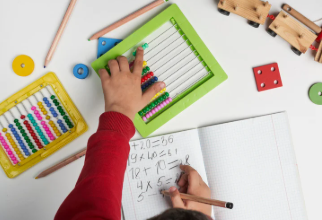
You probably know this child.
They count on their fingers in fourth grade — quietly, under the desk, hoping no one notices. They got a math problem right on Tuesday and can't do it on Thursday. And they have no idea why. They lose their place in the middle of a multiplication problem, reverse digits without realizing it, can't make change, struggle to read a clock with hands.
They are not careless. They are not checked out. They have been told to practice more, pay attention, slow down. But they have been working harder than anyone around them realizes.
What they may have is dyscalculia.
Dyscalculia is not a matter of effort or attitude. It is a brain-based difference in how numerical information is processed — as real and as neurological as dyslexia, and just as often missed.
What Dyscalculia Actually Is
Dyscalculia (dis-cal-KYOO-lee-uh) is a specific learning difference that affects a person's ability to understand and work with numbers. The name comes from Latin and Greek roots meaning "difficulty counting."
At its core, dyscalculia is a weakness in number sense — the intuitive understanding of quantity, magnitude, and numerical relationships that most children develop naturally in the early years. If you have ever glanced at a handful of coins and immediately known roughly how much you're holding or looked at two groups of objects and instantly knew which was larger, you have used number sense. For a child with dyscalculia, that intuition is unreliable or absent. Numbers don't carry automatic meaning.
Research consistently points to the intraparietal sulcus (IPS), a region in the parietal lobe central to processing numerical magnitude, as functioning differently in individuals with dyscalculia. Brain imaging studies find that children with dyscalculia show atypical activation patterns in the IPS during number tasks, and some show compensatory activity in memory and planning regions of the brain, suggesting they are working around — rather than through — the core number processing system (Üstün et al., 2021; Butterworth, Varma & Laurillard, 2011). The picture is not simply "less activation" — it is a different pattern of brain activation, one that requires more effortful, indirect processing where number sense should be automatic.
Working memory is also consistently implicated — though the relationship is more nuanced than it might first appear. Research suggests that children with dyscalculia do not necessarily have reduced memory span in the traditional sense. Rather, the demands of numerical tasks — holding quantities in mind, tracking steps in a multi-step problem, keeping place in a sequence — place unusual strain on working memory that was not designed to carry that load. When number sense is unreliable, working memory is forced to compensate, and compensation has limits. Children with dyscalculia frequently find that performance degrades under pressure, distraction, or fatigue (same as those with ADHD) — not because they forgot what to do, but because the mental support structure gives way.
Dyscalculia affects an estimated 3 to 7 percent of school-age children, though estimates vary depending on how strictly the condition is defined and which cutoffs researchers use (Haberstroh & Schulte-Körne, 2019). Despite affecting millions of children, dyscalculia receives far less research attention, far less funding, and far less recognition in schools and homes than reading disabilities of similar prevalence.
Dyscalculia Looks Different in Every Child
No two children with dyscalculia look identical, and the profile shifts with age. In the early grades, it tends to show up as:
• Difficulty counting objects reliably or understanding that the last number counted tells you how many there are
• Trouble recognizing small quantities without counting (called subitizing — knowing at a glance that there are three dots without counting them)
• Confusion with number order and what numbers mean relative to each other
• Difficulty connecting number symbols (3) to their quantities (three objects)
By upper elementary, the picture often looks like this:
• Losing track of steps in multi-step problems even when the concept is understood
• Reversing digits (writing 21 for 12, 63 for 36) without noticing
• Difficulty with multiplication facts despite extensive practice
• Struggling to tell time on an analog clock or estimate how long something will take
• Trouble with money, making change, or quickly estimating costs
• Difficulty understanding fractions, decimals, and place value conceptually
One of the most confusing features of dyscalculia — for parents, teachers, and the children themselves — is its inconsistency. A child can demonstrate understanding of a concept on Monday and seem to have lost it entirely by Friday. This is not forgetting in the typical sense. It reflects the unreliability of a number sense that was never automatic to begin with: without a stable intuitive foundation, learned procedures are fragile under pressure, distraction, or fatigue.
What Dyscalculia Is Not
Because dyscalculia is underdiagnosed and widely misunderstood, it is worth being direct about what it is not.
It is not low intelligence. Dyscalculia occurs across the full range of intellectual ability. Many children with dyscalculia are highly capable, verbally strong, and creative thinkers. Their difficulty is specific to numerical processing, not general learning.
It is not laziness or carelessness. The inconsistency and errors that characterize dyscalculia look like inattention from the outside. They are not. These children are often expending enormous effort to compensate for a system that does not work reliably for them.
It is not the same as math anxiety. Math anxiety — fear and stress around mathematical tasks — is real and common, and it does interfere with performance. But math anxiety is an emotional response. Dyscalculia is a neurological difference. Importantly, they frequently travel together: years of struggling with math, being misunderstood, and watching peers succeed can produce significant math anxiety as a secondary effect. Treating the anxiety without addressing the underlying dyscalculia will not resolve the difficulty.
It is not something a child will grow out of. Dyscalculia does not resolve with time or maturity. What changes is the child's ability to develop strategies and workarounds — but the underlying difference in number processing persists. Early identification and support change the trajectory.
Dyscalculia Rarely Travels Alone
Like dyslexia and ADHD, dyscalculia frequently co-occurs with other learning differences. Research suggests that up to half of children with dyscalculia also have dyslexia, and a significant percentage also meet criteria for ADHD.
This overlap is not coincidental. Working memory is a common thread. The same working memory demands that make multi-step math problems difficult also make holding words in mind while decoding harder and make sustained attention more taxing. A child who struggles in all three areas is not simply unlucky — they may be experiencing the downstream effects of a shared neurological difference in how the brain manages and processes information.
Dysgraphia — difficulty with the physical and cognitive demands of writing — also co-occurs with dyscalculia more often than chance would predict, particularly because both involve spatial processing and the challenge of translating mental representations into external form.
This matters practically: a child who is identified with one learning difference should always be assessed for others. A child who struggles with both reading and math is not experiencing two separate, unrelated problems. They may need support that addresses their underlying processing profile rather than targeting each subject in isolation.
Strategies That Actually Help
Knowing what dyscalculia is changes how you see a struggling child. Knowing what to do about it changes what happens next.
Dyscalculia, like dyslexia, does not have a cure, but it is very much teachable-around. The goal is not to fix number sense overnight but to build understanding from the ground up and reduce the working memory demands that make math harder than it needs to be.
1. Start Concrete — and Stay There Longer Than You Think You Need To
The Concrete-Representational-Abstract (CRA) progression is one of the most well-supported approaches for students with math learning differences. It means starting with physical objects (blocks, counters, base-ten pieces), moving to pictures or diagrams, and only then introducing abstract symbols and equations. Most math instruction rushes to the abstract too quickly for students who haven't yet built a reliable mental model of what those numbers mean. For children with dyscalculia, the concrete stage deserves far more time and should remain available as a support even after abstract work begins.
For parents: use physical objects at home. Counting out coins, measuring ingredients, building with blocks are not baby activities. They are building number sense in a way that flash cards and worksheets cannot.
2. Use Visual Models Consistently
Number lines, ten frames, place value charts, and bar models reduce the demand on a working memory that is already strained. When students can see the relationships between numbers rather than holding them invisibly in mind, they can focus cognitive resources on mathematical thinking. The key word is consistently — visual models work when they are used reliably, not pulled out only during intervention.
For teachers: make visual models a standard part of instruction, not a remediation tool. A number line on every desk is not a crutch — it is a scaffold that allows the actual math to happen.
For parents: Talk with your child's teacher about what visual models you can use to support your child at home.
3. Reduce Working Memory Load
Multi-step problems are not just conceptually hard for students with dyscalculia — they are neurologically taxing. Providing written step sequences, allowing the use of number lines or multiplication charts, and permitting calculators for computation (so cognitive resources can go toward problem-solving) are not shortcuts. They are accommodations that allow a student to demonstrate mathematical understanding despite a processing difference. The goal of math instruction is mathematical thinking, not computation by hand. Separating those two things is a critical shift for students with dyscalculia.
4. Use Explicit, Structured Math Instruction
The parallel to structured literacy is not accidental. Just as children with dyslexia need explicit, systematic phonics instruction rather than immersion and guessing, children with dyscalculia need explicit, structured math instruction rather than discovery-based approaches that assume intuitive number sense will develop on its own. That means teaching mathematical concepts directly, breaking them into explicit steps, building new concepts on previously mastered ones, and providing immediate, corrective feedback. Structured math instruction does not mean rote memorization. It means deliberate, carefully sequenced teaching that does not leave number sense to chance.
The Bottom Line
Dyscalculia is real, it is neurological, and it is more common than we think. It is not a dislike of math, not a motivation problem, and not something that resolves with enough worksheet practice. It is a difference in how the brain processes numerical information and it deserves the same recognition, the same research attention, and the same structured support that we have increasingly extended to dyslexia.
The child counting on their fingers under the desk is not failing to try. They are working extremely hard and what they need is not more drilling of the same approaches that haven't worked. They need instruction that meets their brain where it actually is.
Understanding dyscalculia is the first step. And understanding it — really understanding it — changes what we do next.
Your Turn
Have you seen dyscalculia in a child you teach or parent? What did it look like before you had a name for it — and did having a name change anything?
If you are a teacher: have you found specific strategies or tools that made a real difference for students who struggle with number sense? What shifted the experience for them?
If you are a parent: what has been the hardest part of supporting a child who struggles with math — the academics, the emotional toll, or navigating the system to get support?
Drop a comment. This series exists because these conversations matter.
Subscribe so you don't miss the next article.
