What Is Dyslexia — And What Isn’t
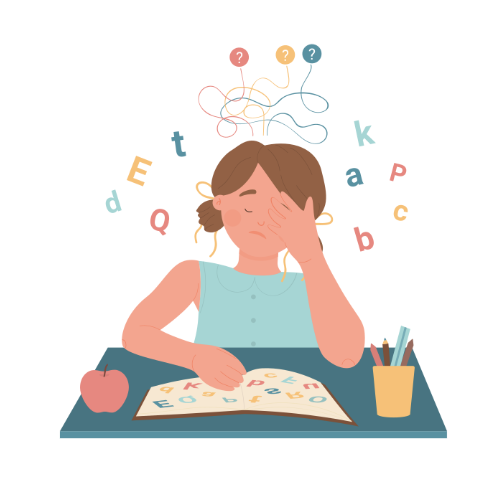
For most of my teaching career, I thought I knew what dyslexia was. A child who flips letters. Who sees a “b” and reads it as a “d.” Who writes words backwards. That was the picture in my head, and I suspect it’s the picture in a lot of heads, maybe even yours.
I was wrong. Though not entirely — letter reversals can be one sign among many. But that image captures almost nothing of what dyslexia actually is, how it actually works in the brain, or why it matters so much that we understand it correctly.
About two years ago, I completed a professional development course that dove deep into the neuroscience and research behind dyslexia. And I was shocked. Genuinely shocked. Not by the complexity of the research — but by this: an estimated one in five people may be dyslexic.
One in five.
I had used approaches grounded in reading science in my teaching, and they had helped my students. But I hadn’t fully understood why they were working, or, more painfully, why some students still weren’t getting there. Sitting in that course, I kept thinking about the students I had taught over the years. The ones who worked so hard and still struggled. The ones who went quiet during reading. The ones I thought just needed more time, more effort, more practice, when what they may have actually needed was more of the right kind of instruction, delivered earlier, with a clearer understanding of what was driving the difficulty. The ones who may have been sitting with dyslexia that nobody named and nobody addressed.
And then I thought about the children sitting in classrooms right now — today — while you are reading this. One in five. That is not a small number. That is the child in the third row who goes quiet when it is time to read aloud. That is the kid who takes the book home every night and comes back the next morning no further along. That is, in all likelihood, someone you know.
That experience is one of the reasons I started writing about reading science. Because what I didn’t know was costing children something real. And the more people who understand what dyslexia actually is (parents, teachers, anyone who works with children), the fewer students get left behind.
So let’s start from the beginning.
A New Definition — And Why It Matters
In October 2025, the International Dyslexia Association released its first formally revised definition of dyslexia in more than twenty years. This is significant. The science has moved forward considerably since 2002, and the new definition reflects that progress.
The IDA now defines dyslexia as:
“Dyslexia is a specific learning disability characterized by difficulties in word reading and/or spelling that involve accuracy, speed, or both and vary depending on the orthography. These difficulties occur along a continuum of severity and persist even with instruction that is effective for the individual’s peers. The causes of dyslexia are complex and involve combinations of genetic, neurobiological, and environmental influences that interact throughout development. Underlying difficulties with phonological and morphological processing are common but not universal, and early oral language weaknesses often foreshadow literacy challenges. Secondary consequences include reading comprehension problems and reduced reading and writing experience that can impede growth in language, knowledge, written expression, and overall academic achievement. Psychological well-being and employment opportunities also may be affected. Although identification and targeted instruction are important at any age, language and literacy support before and during the early years of education is particularly effective.”
— International Dyslexia Association, 2025
A note on two terms in that definition: orthography refers to a language’s writing system — how words are spelled and written. Phonological processing refers to the brain’s ability to hear and work with the individual sounds in spoken language.
There is a lot packed into those sentences. Here is what matters most.
It exists on a continuum
Dyslexia is not a switch that is either on or off. It ranges from mild to severe. One child may read slowly but accurately. Another may read both slowly and inaccurately. Both may have dyslexia. The variation is real and wide.
It persists even with good instruction
This is the part that distinguishes dyslexia from a reading gap that can be closed with extra practice or more time. Children with dyslexia need something more targeted: direct instruction designed specifically for how their brains are processing language.
Phonological and morphological processing are at the root
The new definition explicitly names both phonological processing (the ability to hear and manipulate sounds in spoken language) and morphological processing (the ability to recognize and use units of meaning like prefixes, suffixes, and root words) as common underlying difficulties. These are language-based challenges, not visual ones. Most children with dyslexia struggle to connect print to sound and meaning, not to see letters correctly.
The causes are complex
Dyslexia runs in families. It has neurobiological roots. But environment matters too, including the quality and timing of the instruction a child receives. This is not about blame. It is about understanding.
It affects more than reading
The 2025 definition now explicitly recognizes that dyslexia can affect psychological well-being and employment opportunities, shaping a child’s sense of themselves, their confidence, their willingness to try. Years of struggling with something that seems easy for everyone else leaves a mark that goes well beyond the reading difficulty itself.
Early support makes the greatest difference
The updated definition is clear on this point: while identification and targeted instruction are important at any age, language and literacy support before and during the early years of education is particularly effective. This is not a reason to panic if a child is older. It is a reason to act without delay.
What Dyslexia Is Not
Because the misconceptions are so widespread, and because I held several of them myself for years, it is worth naming them directly.
It is not primarily a visual problem
The b/d reversal image is the most persistent myth about dyslexia, and it is misleading. Dyslexia is fundamentally a language processing difficulty, rooted in phonological and morphological awareness. Children with dyslexia struggle to connect letters to sounds and meaning, not to see letters correctly. Letter reversals are common in all beginning readers and are not a reliable indicator of dyslexia on their own.
It is not a sign of low intelligence
Dyslexia has no relationship to a child’s ability to think, reason, create, or problem-solve. Some of the most brilliant and highly successful people across every field have dyslexia: the arts, medicine, finance, sports, science, and beyond. This is worth sitting with.
Many students with dyslexia are so intelligent that they develop sophisticated coping strategies to compensate for their reading difficulty: memorizing, pattern-matching, listening acutely, reading social cues. And those strategies can work for years.
Until they don’t.
Until the demands of school outpace what coping alone can manage, and the gap becomes impossible to hide. By that point, a child who needed early support has often spent years believing something is fundamentally wrong with them. The reading difficulty is real. The intellectual capacity is not diminished. Not even slightly.
It does not mean a child will never read well
With early identification and targeted instruction, children with dyslexia can and do learn to read. Research has shown that intensive, specialized intervention can strengthen the brain connections involved in reading with consistent, targeted support. The trajectory is not fixed. What matters enormously is when support begins and what kind it is.
It is not the same as being a slow learner
Dyslexia is specific to reading and spelling. A child can have remarkable strengths in mathematics, science, oral language, or creative thinking while struggling significantly with decoding print. Dyslexia affects one particular pathway, specifically the one that connects print to sound and meaning, not the whole mind.
Signs to Watch For
Because dyslexia exists on a continuum, the signs vary from child to child. But some patterns appear consistently across the research.
Before a child begins to read, early signs can include:
• Difficulty learning to rhyme
• Trouble remembering letter or number names
• Slow acquisition of new vocabulary, often struggling to find the right word
• Difficulty following multi-step directions
• A family history of reading or spelling difficulties
Once a child is in school, signs often include:
• Slow or labored reading
• Difficulty sounding out unfamiliar words
• Persistent inconsistency with common words — correctly reading “said” or “they” one day and missing them the next, despite repeated practice
• Inconsistent spelling — sometimes spelling the same word differently within a single piece of writing
• Fatigue after reading
• Avoidance of reading tasks
That last one is important. Avoidance is often misread as laziness or lack of motivation. It is almost always something else: a child who has learned, through repeated experience, that reading is hard for them and that trying is likely to end in struggle or embarrassment.
One more thing worth knowing: dyslexia often does not travel alone. It frequently co-occurs with ADHD, dysgraphia (difficulty with the physical act of writing), dyscalculia (difficulty with numbers and math), and dyspraxia (difficulty with coordination and movement). A child who is identified with one of these does not automatically have the others. But if a child is struggling across multiple areas, it is worth asking whether more than one thing might be going on. A full picture matters — because each piece of it points toward a different kind of support.
One important note: signs of difficulty do not, on their own, confirm a diagnosis of dyslexia. Formal identification requires assessment. But signs are always worth taking seriously and following up on early, because early is when intervention matters most.
A Movement Worth Knowing About
Something significant is happening across the country right now, and parents and teachers both deserve to know about it. Many states across the country have now passed legislation addressing dyslexia in public schools, and a growing number require dyslexia-specific screening in the early grades, a movement that has accelerated significantly over the past several years and shows no signs of slowing.
This is a meaningful shift. For decades, the standard approach was essentially to wait — wait until a child had failed enough to qualify for evaluation, wait until the gap was wide enough to be undeniable. The research has long told us that waiting is exactly the wrong strategy. The earlier intervention begins, the better the outcomes. The screening movement is the policy world catching up to what the science has shown for years.
What this means practically: many schools are now required to screen young children for early indicators of dyslexia risk, including phonological awareness, letter sound knowledge, and the ability to quickly name letters and numbers. If your child is in kindergarten through third grade, it is worth asking whether your school conducts this screening and what the results showed.
What Parents and Teachers Can Do
The most important thing the research tells us about dyslexia is that early identification changes outcomes. That is not cause for panic. It is cause for attention and action.
For parents:
If something feels off about how your child is approaching reading, if they are working much harder than seems right, avoiding books, or falling behind peers in ways that don’t match their intelligence or effort, trust that instinct. Talk to the teacher. Ask specifically about phonological awareness or dyslexia screening (sometimes called a universal screener). Ask what the results show. You do not need to wait for a formal diagnosis to advocate for more targeted support.
A sample of language to use: “I’d like to understand what data we have on my child’s phonological awareness and decoding skills, and what we’re doing specifically to support them.”
For teachers:
Children with dyslexia respond to direct, carefully sequenced phonics instruction, delivered with greater intensity, specificity, and consistency than core instruction alone provides. If a student is not responding to core instruction the way peers are, that is important information. It is a signal to dig deeper, not to wait and see.
A sample of language to use with families: “I’m noticing some patterns in how your child is approaching reading that I’d like to understand better. Can we talk about what we’re seeing and what additional screening might tell us?”
For both:
Remember that the child in front of you has probably already noticed that reading is harder for them than it is for everyone else. What they need, alongside the right instruction, is to know that the difficulty is not a reflection of who they are, and that it can get better.
The Bottom Line
Dyslexia affects an estimated one in five people. It is the most common learning disability, representing the vast majority of all reading difficulties. It is rooted in how the brain is wired, runs in families, and is nobody’s fault. It is not a vision problem. It has nothing to do with intelligence. And with the right instruction, early enough, it does not have to define a child’s relationship with reading.
The word dyslexia can feel frightening. It doesn’t need to. It is, at its most useful, a description — a way of understanding why a particular child is working so much harder than their peers to do something that should be getting easier. And a description, unlike a mystery, is something we can act on.
If there is one thing I wish I had understood earlier in my teaching career, it is this: the students who struggled most weren’t struggling because they weren’t trying. Many of them were trying harder than anyone knew. They just needed someone who understood what was actually going on, and knew what to do about it.
The next time you are at the grocery store, a restaurant, or your child’s school pickup line — look around. One in five of the people near you may be dyslexic. That is the parent helping their child sound out a menu. That is the adult who still avoids reading aloud. That is the child in the classroom right now who is working twice as hard as the kid next to them just to get through a paragraph.
Dyslexia is one of the most common hidden crises in education. And beyond it. Because the children who slipped through the cracks don’t disappear. They become teenagers who hate reading. Adults who avoid anything that requires it. People who have spent decades believing something is fundamentally wrong with them, when what was wrong was that nobody identified what they needed and gave it to them early enough.
The consequences of unidentified dyslexia don’t end in childhood. Research consistently shows that individuals whose dyslexia goes unrecognized and unsupported face higher rates of anxiety and depression, lower rates of graduation and employment, and are significantly overrepresented in the prison population — not because dyslexia causes these outcomes, but because years of struggling without the right support can set off a chain of consequences that are very hard to reverse. Early identification doesn’t just help a child learn to read. It changes the trajectory of a life.
We have the research.
We have the tools.
What we don’t yet have is a guarantee that every child — and every adult — who needs support will get it. Early enough. Specifically enough. Consistently enough to make the difference it should make.
That is the work still in front of us. And it starts with understanding.
Ask questions. Push for screening. Believe children when they struggle. Advocate for support — for the five-year-old just starting kindergarten, for the third grader who has been quietly falling behind, and for the adults in your life who may have been carrying this silently for years.
Your Turn
Did anything in this article surprise you? Is the b/d reversal image where your understanding of dyslexia started too?
If you’re a parent: has your child’s school mentioned dyslexia screening? Do you know whether your state requires it in the early grades?
If you’re a teacher: what does your school’s process look like for identifying students who may need more targeted reading support? Is there a clear next step when a child isn’t responding to core instruction?
Subscribe to always get the next article!
