How Memory Works — And Why It Matters for Reading
Do you remember Concentration? The card game where you spread a deck face down, flip two at a time, and try to remember where the matches are? As a child, the goal was simple: remember more cards than your opponent. Nobody explained what was happening inside your brain while you played. Nobody needed to. You just remembered — or you didn’t.
For most of my teaching career, I thought about memory roughly the same way. Students either retained information or they didn’t. They studied, they practiced, they remembered. The brain was something like a filing cabinet: information went in, you found the right drawer, you pulled it out. That metaphor seemed reasonable enough. It wasn’t one I’d ever thought to question.
I had received training in building background knowledge, and I used those approaches in my classroom. They helped. But nobody had ever explained to me what was actually happening inside the brain while I did it. Why background knowledge mattered neurologically, not just practically. The filing cabinet was still the best mental model I had.
Then I attended a lecture on the neuroscience of memory, and everything I thought I knew shifted.
What I learned that day has changed how I think about reading instruction. And I think it will change how you think about it too.
How We Think About Memory Has Changed
The history of how scientists have understood memory is itself a story about learning. For a long time, the dominant idea was tabula rasa (the blank slate). The brain starts empty and experience fills it in. Then came the information processing models of the 1960s, which gave us the filing cabinet. Memory, in this model, worked in three stages:
• Sensory input: what you see, hear, and experience in the moment
• Short-term storage: a temporary holding space for what you are currently working with
• Long-term storage: the filing cabinet itself, where information was thought to be kept and retrieved intact
It was a tidy model and not entirely wrong — but it described memory as a passive system where information moved in, was stored, and waited to be retrieved.
Modern neuroscience tells a different story. Memory is not stored in a single location. It is distributed across networks of connected neurons that fire together, strengthen together, and form patterns of activation across the brain. When you remember something, your brain isn’t opening a filing drawer. It’s lighting up a constellation of connections formed through experience, and those connections are different for every person, shaped by everything they have ever seen, heard, felt, and learned before.
One principle captures this beautifully. Donald Hebb, a Canadian neuropsychologist, articulated the principle in 1949 — later summarized as: “neurons that fire together wire together.” When neurons are activated together, repeatedly, the connection between them strengthens. That strengthened connection is the physical reality of a memory. Learning doesn’t just change what you know. It changes the structure of your brain.
Memory Is Distributed Across the Brain
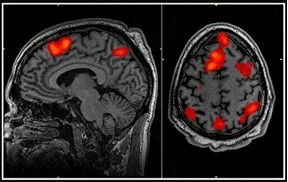
An fMRI scan taken during working memory tasks. The warm colors show regions of the brain actively firing, in this case the prefrontal and parietal cortex. Brain imaging like this has transformed our understanding of how memory works. Credit: John Graner, Walter Reed National Military Medical Center. Public domain. Source
Brain imaging has made this visible in ways that would have seemed impossible a generation ago. What brain imaging scans show is not a tidy system of labeled compartments, like a filing cabinet. They show networks: multiple regions activating together, each contributing something different to the memory being formed or retrieved.
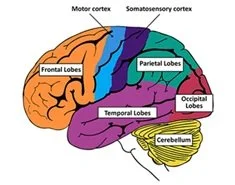
The brain’s major regions. The hippocampus and amygdala are interior structures not visible on this surface view, as both are buried deep inside the temporal lobe. Source NIH.
Here is what each region contributes:
• Prefrontal cortex: Just behind your forehead, at the very front of the brain. Primary role: working memory (the information you hold in mind while actively thinking). This is short-term, limited-capacity storage. It is also involved in connecting past experiences to present situations.
• Cerebral cortex: The large, folded outer layer, the wrinkled surface you picture when you think of a brain. Primary role: long-term memory storage. Once a memory is consolidated, it is distributed across regions of the cortex depending on its type — language, visual information, or facts about the world.
• Hippocampus: A deep interior structure buried inside the temporal lobe, the region running along the side of your head, roughly level with your ear. Not visible from the outside, which is why it doesn’t appear on the surface diagram above. Critical bridging role: it takes information from working memory and converts it into long-term memory. It is also central to the linking of new information to existing knowledge.
• Amygdala: A small, almond-shaped structure (its name means almond in Greek) tucked deep inside the temporal lobe, just in front of the hippocampus, and the two are close neighbors. Not visible from the outside. Primary role: emotional memory. It tags memories with emotional significance, which is why experiences connected to strong feelings are remembered more vividly and durably than neutral ones. This is part of why read-alouds that make children laugh, wonder, or feel are so powerful for building lasting memory.
• Cerebellum: Lower back of the brain, with its own visibly distinct and tightly folded surface. You can see it clearly at the lower right of the diagram above. Primary role: procedural and motor memory, learned physical patterns that become automatic. Reading fluency has a significant motor component, which is part of why repeated, accurate oral reading practice matters so much for making reading feel effortless and automatic.
We Interpret New Information Through What We Already Know
Here is where neuroscience connects most directly to teaching and learning: the brain does not receive new information neutrally. It interprets everything through the lens of what it already knows.
Researchers call this schema. Think of schema as a web of prior knowledge. New information is what gets caught in it. The denser the web, the more new learning sticks, and the more connections form between what a child already knows and what they are learning next.
The research on this is consistent and striking. New experiences that connect to existing knowledge are encoded more easily and more durably than experiences that arrive in a vacuum. Brain imaging studies show that when people learn information that links to what they already know, the hippocampus and prefrontal cortex work together in ways that produce stronger, more lasting memories.
In plain terms: what a child already knows is not just helpful context for reading. It is the scaffolding on which new memory is built. A child who already knows what a harbor seal is, who has heard the word luminous, who has been read to about ancient civilizations — that child will encode new text about those topics more easily and remember it more durably. This is not a matter of intelligence. It is a matter of what was built before.
What This Means for Reading
Understanding how memory actually works reframes several things that might otherwise seem like mysteries.
It explains why a child can hear a word dozens of times and still not reliably remember it. If the learning was shallow, if the connections were never made through sound and meaning, if the word was never deeply processed — it was never durably stored. As we explored in the orthographic mapping article, this is exactly why flash cards and visual repetition alone don’t build lasting word memory. The connection has to be made through sound, not shape. A child who sees a word fifty times but never connects it to its sounds has not yet learned that word.
It explains why background knowledge matters so much for reading comprehension. New text is interpreted through existing schema, and a child with a richer store of knowledge will comprehend more, remember more, and build more connections from the same reading experience than a child without that foundation.
And it explains why the early years of literacy instruction are not simply about getting children ready to read. Every time a child connects a letter to a sound, every time a word is decoded and mapped into memory, every time a story is heard and connected to things already known, connections between neurons are being strengthened. Neurons that fire together wire together. The brain is most plastic in the early years, most primed to form the durable connections that become the foundation of fluent reading. Structured, explicit instruction doesn’t just teach decoding. It builds a brain.
Next week we will look at what all of this means for practice — and why not all practice produces the same results.
Your Turn
Did the filing cabinet metaphor shape how you thought about memory? What would you do differently knowing what you know now about how the brain actually stores information?
If you’re a parent: think about the books you’ve read aloud, the conversations you’ve had, the knowledge you’ve built with your child. That isn’t just enrichment. That is the scaffolding for everything they will read.
If you’re a teacher: does understanding the neuroscience of schema change how you think about background knowledge instruction? It changed how I think about it entirely.
Subscribe so you don’t miss next Sunday’s article.
