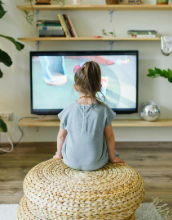
How much screen time is too much?
It is one of the most common questions parents ask — and one of the most guilt-laden. We hand a child a tablet to get through a car ride or finish a work call and immediately wonder if we have done something wrong. The headlines do not help. “Screen time linked to lower reading scores.” “Too much screen time rewires children’s brains.”
So what does the research actually say? The honest answer is more nuanced than those headlines suggest — and more useful.
The Most Important Finding You Probably Haven’t Heard
In 2024, researchers published a large research review in JAMA Pediatrics covering 100 studies on screen time and child development. It is one of the most comprehensive reviews on this topic to date.
The headline finding: more screen time was linked to worse thinking and learning outcomes. That part made the news.
What did not make the news: when parents watched with their children and talked about what was on screen, screen use was associated with better thinking and learning outcomes. The same screen, the same content — a different result based entirely on whether an adult was present and engaged.
The researchers concluded that the question is not simply how much time children spend in front of screens. It is what they are watching, with whom, and what happens around it.
What the Broader Research Shows
A large 2026 review of research reviews in JAMA Pediatrics pooled data from 23 earlier studies covering nearly 2.8 million children across 64 countries. It found negative associations between screen time and school achievement as well as language development, real and consistent across countries and age groups.
And here is the finding that tends to disappear in coverage: when researchers looked at reading specifically, they found no meaningful connection. The association between screen time and reading scores was not statistically significant.
A separate long-term study out of Ontario followed more than 3,000 children from early childhood through grades 3 and 6. It found that each additional hour of daily screen time in early childhood was associated with a 10% drop in the likelihood of achieving higher academic levels. That sounds alarming, and it is worth taking seriously, but the study tracks associations. It shows a relationship, not a cause.
The Background TV Problem
Across multiple studies and reviews, one finding is unusually consistent: background television is the highest-risk category of screen use for young children.
A television on in another room, or playing while a child eats, plays, or does homework, is not neutral. It fragments attention, interrupts parent-child conversation, and reduces the kind of responsive back-and-forth that builds vocabulary and listening comprehension. This holds even when the child is not watching.
A large 2024 Danish study found that frequent reading to a child moderated the negative effects of mobile screen time on language comprehension, meaning that shared book reading appears to serve as a buffer.
What This Means for Your Family
The research is not a reason to panic — but it is a reason to be intentional. It points clearly toward a few things:
· Background television carries real risk. A show on in another room is not harmless downtime. It crowds out the conversation that builds language.
· Who is in the room matters as much as what is on the screen. Watching together and talking about it (asking questions, naming things, connecting it to real life) changes the outcome.
· Not all content is equal. Child-directed educational programming does not carry the same negative associations as passive or age-inappropriate content. What is on the screen matters.
· Print reading is still the highest-value activity for literacy development. It is not about being anti-screen. It is about knowing what works best for building readers.
· The goal is not zero screens — it is balance. The research is clear that books, conversation, and play are the highest-value activities for building readers. Screens can have a place in a child’s day without crowding those things out.
The Bottom Line
Screen time and reading is not a simple cause-and-effect story. The research shows real associations between heavy, passive screen use and weaker language and literacy outcomes. But screen time alone does not explain reading outcomes, and the most important variable is not how many hours a child spends on a screen. It is what they watch, whether anyone watches with them, and whether books still have a place in their daily life.
The question worth asking is not “how many minutes did my child spend on a screen today?” It is “what did they watch, and did we talk about it?” The most reliable thing a family can do for a child’s reading development is still the simplest: read together, talk about what you read, and do it regularly. Screens are part of modern life, but they work best alongside books, not instead of them.
Your Turn
I’d love to hear from you:
· Do you have a screen time approach that works for your family? What helped you find it?
· Have you noticed a difference in how your child engages with books versus screens?
· For teachers: how do you address screen time questions when parents bring them up?
If you found this useful, share it with a parent who might need it. New articles come out each week.
