How Literature Teaches Empathy — And Why That Matters
You probably remember the first time a book broke your heart. I do.
Charlotte’s Web, Where the Wild Things Are, Number the Stars — I read all three in elementary school and have never forgotten them. Not the plots, exactly, but the feeling. The moment at the end of Charlotte’s Web when you understood that something you loved could simply be gone. The wild rumpus and the supper that was still hot and the way you felt Max’s longing before you even had words for it. The quiet, terrifying bravery of an ordinary Danish girl doing an extraordinary thing. Decades later, those feelings are still there, strong enough that I brought these books into my classroom, and strong enough that I still press them into the hands of people I love.
These books did not just make you feel something. They made you feel something on behalf of someone else. They made you practice, without realizing it, one of the most important human capacities: the ability to step inside another person’s experience.
That capacity has a name. And it turns out the research has a lot to say about how it develops, and what helps it stick.
What Empathy Actually Is
Empathy is not just feeling bad when something bad happens to someone. That is sympathy. Empathy is something more specific: the ability to understand and share the feelings of another person, to take their perspective as your own, even briefly, even imaginatively.
Psychologists sometimes distinguish between two types. Cognitive empathy is the ability to understand what another person is thinking or feeling. Affective empathy is the ability to actually feel what they are feeling. Both matter. And research suggests both can be developed, at least in part.
Researchers have long studied what builds empathy in children. Travel. Diverse friendships. Being raised by adults who talk openly about feelings and other people’s experiences. And reading fiction, particularly the kind that asks you to inhabit a character’s inner life.
What the Research Shows
The connection between fiction and empathy is not just a feeling teachers and parents have always had. It is a finding that has held up across decades of research.
Readers of fiction consistently score higher on measures of empathy and theory of mind than non-readers, even after controlling for personality, gender, and other individual differences. Theory of mind is the technical term for what most of us call reading the room: the ability to think about other people’s thoughts and feelings, to recognize that other people have inner lives different from our own.
Neuroscience shows that reading about a character’s inner life recruits the same brain systems we use to understand real people. Fiction doesn’t blur reality, but it does exercise the neural machinery of social experience — letting us rehearse lives we haven’t lived.
But not all fiction works equally well. Research has found that fiction influences empathy only when the reader is genuinely transported into the story — fully absorbed, lost in the characters, temporarily forgetting where they are. When that transportation happens, the empathy effect is real and measurable. When it doesn’t, the effect largely disappears.
Think about what Number the Stars does. Annemarie’s fear, her confusion, her gradual understanding of what is happening around her: Lois Lowry never over-explains it. The reader has to construct it. That construction pulls readers in, and that pull, the research suggests, is part of what makes the book do its empathy work.
The Honest Question: Does It Actually Transfer?
Here is where the research gets more complicated, and more interesting.
A reasonable question to ask is whether any of this actually transfers to real-world behavior. Does reading about a character’s grief make a child more compassionate toward a grieving classmate? Does inhabiting Annemarie’s perspective make a child more likely to stand up for someone who is being treated unfairly?
The honest answer is: sometimes, and it depends.
Research has identified what may be the most important condition: emotional transportation. As we saw in the research section, readers who are fully absorbed — lost in the characters, temporarily forgetting where they are — show real and measurable empathy effects. Readers who are disengaged do not. The transfer question, then, may be less about whether fiction builds empathy and more about whether the reading experience is genuine.
There is also a genuine chicken-and-egg question in the research. Empathetic people may simply enjoy fiction more, which means the relationship between reading and empathy could run in both directions. The research has not fully resolved this. What it has established is that the two are meaningfully connected, and that the connection is strongest for readers who are genuinely transported.
This matters practically. A child reading a book they cannot connect with, in a setting where they feel no investment in the characters, is probably not building much empathy. A child reading a book they love, one that keeps them up past their bedtime, probably is.
The Part That Makes the Biggest Difference
Here is the finding that surprised me most when I looked at the research, and the one that has the most direct practical implications.
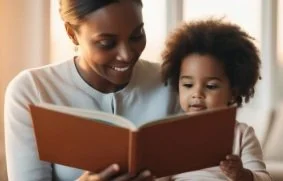
Reading fiction alone builds empathy. But reading fiction and talking about it with an adult builds significantly more.
A 2025 meta-analysis found that shared reading sessions with high adult interactivity strengthen children’s empathy.
Through guided discussions with a teacher or parent, children progressively learn to identify the emotions of story characters, recognize their own emotions, differentiate their feelings from those of others, and develop empathy across a variety of scenarios. The conversation is not a nice addition to reading. The conversation is part of how the learning happens.
Adult-child conversations about feelings and emotions provide a crucial context for coaching children in understanding both their own and others’ emotions. The book opens the door. The conversation is what children walk through.
This is why asking a child what they thought of a chapter matters more than it might seem. Not a quiz. Not a comprehension check. Just genuine curiosity: What did you think was going to happen? How do you think she felt when that happened? What would you have done?
What This Means for Home and Classroom
Choose books that don’t explain everything
The books that build empathy most effectively are the ones that require the reader to do some of the emotional work. Books with complex, psychologically rich characters. Books where the reader has to infer what a character is feeling, rather than being told. This is one reason books that leave emotional space for the reader tend to do more empathy work than books that spell everything out, and one reason the classics that transported a generation of readers are still worth pressing into children’s hands.
Let children be transported
Emotional transportation is the key condition for empathy effects. This means protecting reading time from interruption. It means letting a child stay up a little later when they are in the middle of something they cannot put down. It means not turning every reading experience into an assignment. A child who is lost in a book is doing something important.
Have the conversation
The research is clear that adult-guided discussion is where a significant part of the empathy-building happens. This does not mean conducting a seminar at the dinner table. It means genuine, low-stakes conversation: What did you think of that part? Did you understand why she did that? What do you think happens next?
For teachers, this is an argument for making discussion time as protected as reading time. The conversation after the reading is not the reward for having done the work. It is part of the work.
What Literature Has Always Done
The books that have stayed with us — Charlotte’s Web, Where the Wild Things Are, Number the Stars — have stayed because they did something very hard to do. They made us care, deeply and genuinely, about a life that was not our own. They gave us practice being someone else.
The books in classrooms today are doing the same work. R.J. Palacio’s Wonder asks readers to inhabit the experience of a child whose face makes strangers stare. Lois Lowry’s The Giver asks readers to imagine a world where emotions have been engineered away, and to feel the loss of that.
This is what literature has always done. And it turns out, the research agrees.
Your Turn
What book first made you feel something on behalf of someone else? And is there a book you have shared with a child that you found opened up a real conversation?
If you are a parent: the next time your child finishes a chapter they loved, try asking one genuine question about the character rather than the plot. Notice what happens.
If you are a teacher: which book in your curriculum do you find produces the most genuine student discussion? What do you think makes it work?
Subscribe so you don’t miss next Sunday’s article.
